DTF vs DTG printing: how to choose the right technology for your project
A comparative technical guide between Direct to Film (DTF) and Direct to Garment (DTG). We analyze relative costs, compatible fabrics, wash durability, and how to make the right business choice.
The textile customization market has evolved spectacularly in recent years. While traditional screen printing once dominated any high-volume order and embroidery was the sole option for a premium look, today's digital technologies offer incredible flexibility. Two of the most popular and efficient digital printing methods currently are DTG (Direct to Garment) and DTF (Direct to Film). For a client looking to produce promotional merchandise, corporate uniforms, or products for a custom apparel brand, choosing between the two can be challenging. Each technology comes with distinct advantages, specific limitations, and different cost structures depending on the order volume and the fabric substrate.
What is DTG (Direct to Garment) technology and how does it work
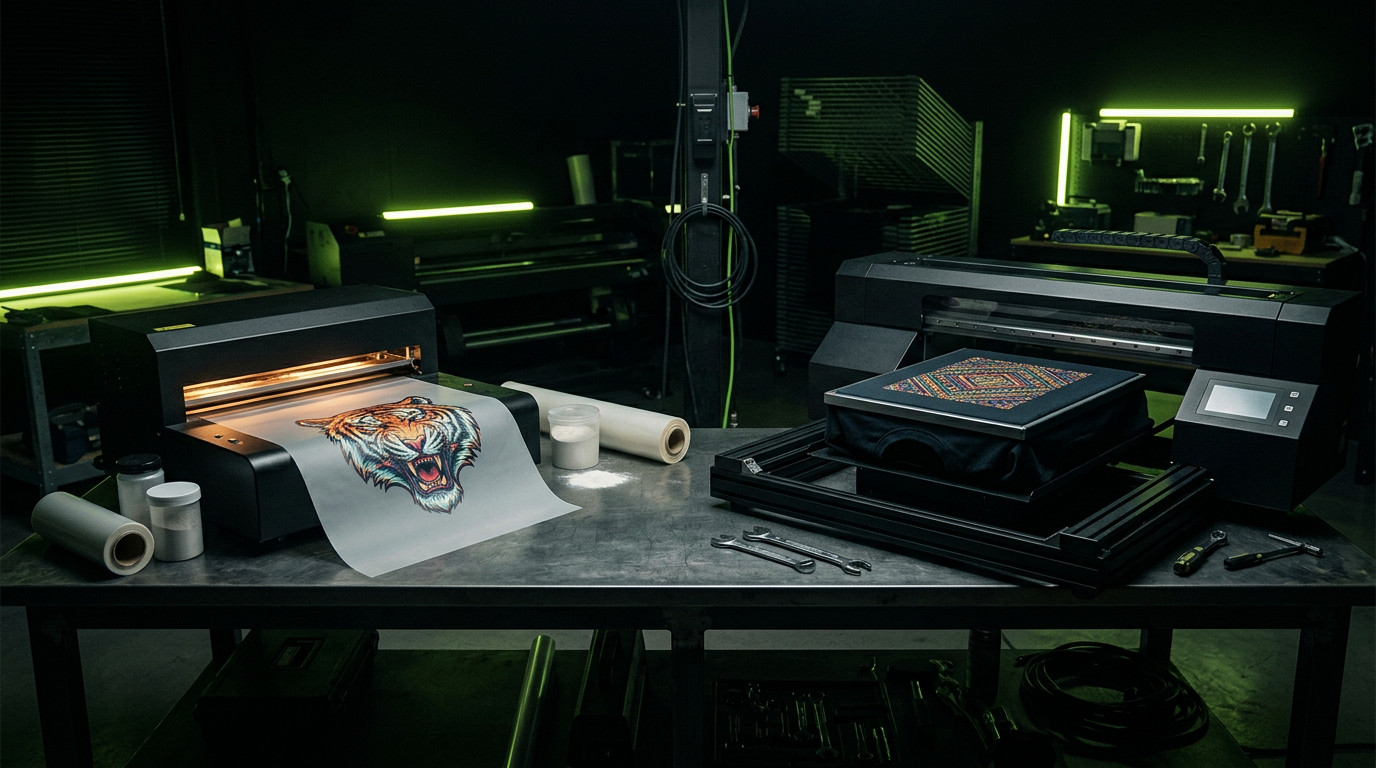
DTG printing is a process where ink is applied directly onto the textile surface using a specialized, high-precision industrial inkjet printer. The operating principle is very similar to a desktop paper printer, but the substrate is a pre-made garment, such as a t-shirt or a canvas tote bag. Before the actual printing, the fabric (especially dark-colored items) must undergo a liquid pretreatment process. This pretreatment prevents the ink from absorbing too deeply into the textile fibers and provides the necessary chemical base for the white underbase ink to cure. After the CMYK inks are applied, the garment is placed in a heat press or a conveyor dryer to polymerize and permanently lock the colors into the fabric.
Main advantages of Direct to Garment (DTG) printing
- Extremely soft handfeel: Since the ink integrates directly into the fibers, the print is practically imperceptible to the touch on light garments and remains very soft on dark ones.
- Excellent breathability: Air flows easily through the printed area, making DTG-printed t-shirts highly comfortable for daily wear.
- Outstanding detail quality: It allows for exceptionally high-resolution prints, subtle gradients, and complex color transitions, making it perfect for photographs or complex artistic designs.
- Ideal for unique prints or very short runs: No screen setups or complex prep work are required, allowing for highly efficient single-unit production.
What is DTF (Direct to Film) technology and how does it work
DTF is a relatively new technology in the industry but has quickly captured a massive market share due to its versatility. Unlike DTG, the design is not printed directly onto the garment in DTF. Instead, it is printed onto a special transparent polyester film (PET film). While the ink on the film is still wet, a hot-melt adhesive powder is automatically applied. The film then passes through a curing oven, melting the powder to form a uniform adhesive layer on the back of the graphic. Finally, the design is transferred from the film to the garment using a heat press under controlled temperature and pressure. Once fully cooled, the carrier film is peeled away, leaving only the applied graphic on the textile.
Main advantages of DTF transfer printing
- Universal fabric compatibility: Unlike DTG, which requires a high cotton content, DTF can be applied to almost any fabric: polyester, nylon, cotton, synthetic blends, leather, or performance fabrics.
- Extremely vibrant colors: Due to the solid white layer printed on the film and the opaque adhesive base, the colors are highly intense, solid, and saturated, even on black or very dark garments.
- Elasticity and durability: The print is highly stretchable, does not crack easily under tension, and shows excellent resistance to repeated washing and physical wear.
- Highly competitive costs for small to medium prints: Multiple designs can be tightly ganged on a single linear meter of film, optimizing the cost per piece for logos and small graphics.
Direct comparison: choosing the right method for your project
To make the right choice between these two technologies for a print production run, we must evaluate several clear technical criteria. There is no universally superior technology, only the right technology for your project's specific requirements.
- Fabric composition: For 100% cotton, both options are viable. For polyester, nylon, or synthetic blends, DTF is the only reliable technical option that prevents dye migration.
- Handfeel: DTG offers an almost weightless print because the ink sinks into the fabric. DTF has a slightly plasticky or silicone-like feel, which is very smooth but noticeable on large-format designs.
- Graphic complexity: DTG excels at extremely soft gradients and color fades that blend smoothly into the fabric texture. DTF is ideal for sharp vector edges, solid color blocks, and crisp details.
- Print size: For large prints (like A3 format) on cotton, DTG preserves the garment's breathability. A large DTF transfer can block air passage, creating a patch-like feel on the chest area.
Logistics, production volumes, and budgeting
From a production workflow perspective in a professional studio like Loop Design ADV, these technologies behave differently. DTF allows transfer films to be printed in advance and stored long-term without any loss in quality. This provides a major logistical benefit: we can print a larger run of transfer films at once and heat-press them onto garments quickly, on demand, as your inventory runs low. DTG requires individual pretreatment, drying, and direct printing for every single item, which is a more labor-intensive workflow suited for quick, premium runs where tactile comfort is paramount.
DTF tends to have slightly better mechanical resistance to repeated washing due to the hot-melt adhesive that forms an incredibly solid bond with the fabric fibers. DTG also lasts exceptionally well on cotton but requires more careful washing (maximum temperature of 30-40 degrees, always inside out) to prevent natural fiber fading over time.
Need a custom solution?
Talk to the LOOP DESIGN ADV specialists and get an offer tailored to your project.
Request a quote